


Parent Voices:
What Hawaiʻi Island Families Told Us
When families talk about early childhood on Hawaiʻi Island, the message is clear: parents are deeply invested in their children’s growth — but the systems meant to support them are under strain.
In 2025, Baby STEPS Hawaiʻi conducted a comprehensive parent survey to better understand family needs, barriers to care, and the ripple effects childcare instability has on keiki, ʻohana, and the workforce. The survey captured responses from 737 Hawaiʻi Island families, across Hawaiʻi island, including rural communities, using online and paper surveys to ensure broad participation.
What we heard reveals both strength and strain — and points toward clear, actionable solutions.
What We Learned at a Glance
Parents are doing the work at home.
73.5% of parents read to their children daily or almost daily, and nearly all families report having children’s books at home.
Cost is the biggest barrier to care.
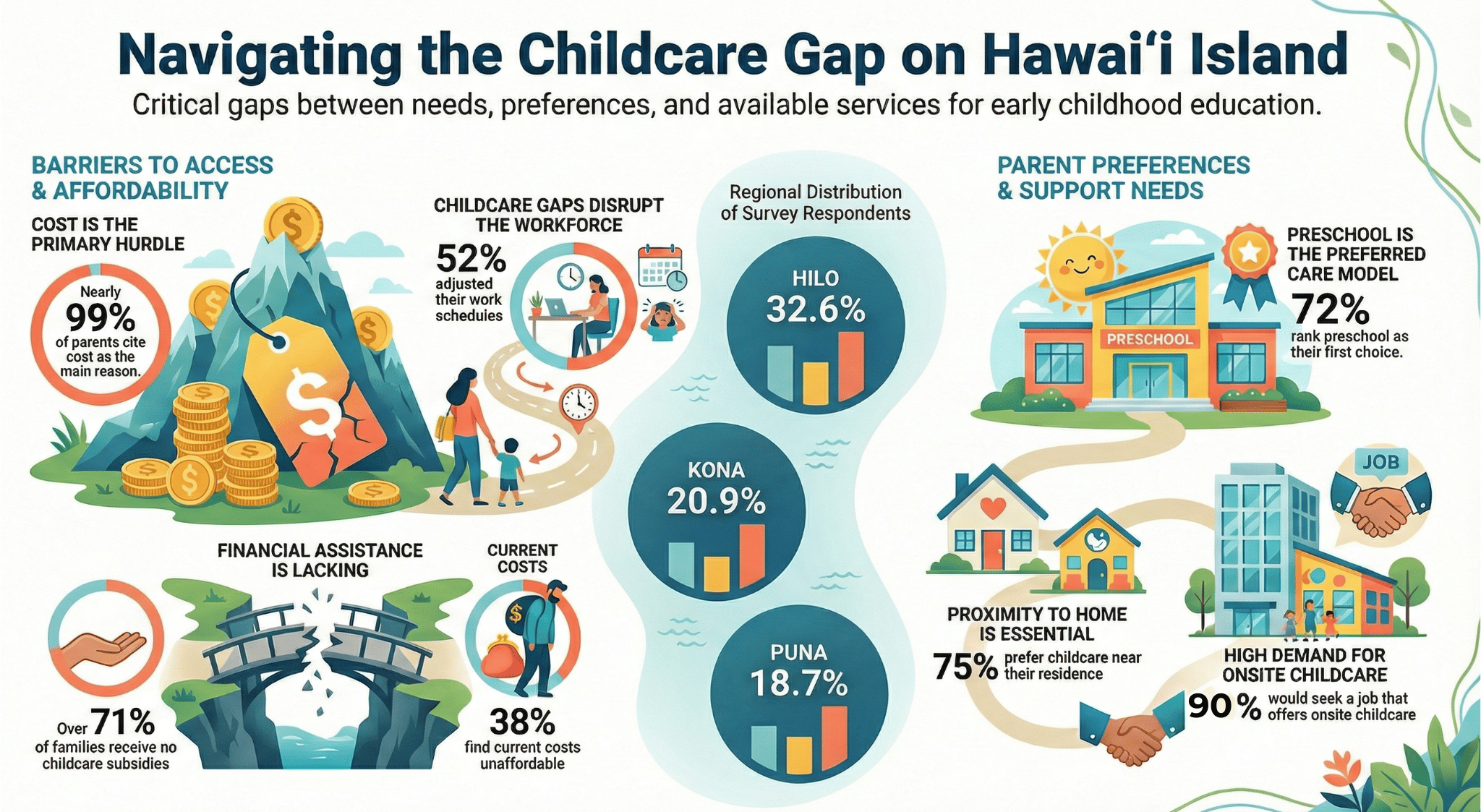
Nearly all parents not currently accessing childcare cited cost as the primary reason.Childcare gaps directly affect the workforce.
Parents are adjusting work schedules, reducing hours, turning down jobs, or leaving the workforce entirely due to lack of care.Families want care close to home.
Neighborhood-based and family childcare options are strongly preferred, especially in rural communities.
-
When childcare isn’t available or affordable, families absorb the impact — and so does the local economy.
More than half of surveyed parents reported adjusting their work schedules due to childcare challenges. Others reduced hours, took unplanned time off, turned down job opportunities, or left the workforce entirely. This isn’t about lack of motivation — it’s about lack of infrastructure.
The data also points to a major opportunity: nearly 70% of parents said they would be more likely to seek or accept a job that offers onsite childcare, signaling strong demand for employer-based solutions.
-
Many Hawaiʻi Island families rely on extended ʻohana to make childcare work. Multi-generational households function as an informal safety net, filling gaps when formal care isn’t accessible.
While this reflects strong family and cultural support systems, it also highlights vulnerability: when that informal care is unavailable, families often have no backup options.
-
Despite system-level challenges, parents are showing up for their children every day.
Home literacy rates are strong, demonstrating that families are engaged, committed, and eager to support early learning. This foundation matters — and it underscores why improving access to affordable, high-quality childcare and early intervention services is so critical.
-
Survey responses came from across Hawaiʻi Island, including Hilo, Kona, Puna, Kaʻū, Kohala, and Hāmākua. Families in rural areas reported fewer options, longer travel times, and greater difficulty accessing care — reinforcing the need for decentralized, neighborhood-based solutions.
-
One of the clearest findings from the survey is what we call the “middle-income trap.”
Many working families earn too much to qualify for childcare subsidies, but far too little to afford market-rate care. This group makes up a large portion of the workforce — and is often the most squeezed, facing impossible choices between employment, caregiving, and financial stability.
-
Parents didn’t just identify problems — they pointed toward solutions.
Based on survey findings, Baby STEPS Hawaiʻi is focused on strategies that:
Expand affordable childcare options, especially for working and middle-income families
Support employer-based childcare and flexible work solutions
Strengthen family childcare homes and neighborhood-based care
Improve clear, digital-first communication so families can navigate services more easily
Invest in early intervention, playgroups, and developmental supports where gaps exist
-
📄 Download the full 2025 Baby STEPS Hawaiʻi Parent Survey Report
📊 View the presentation slides
🤝 Interested in partnering or using this data? Contact usThis data helps guide our programs, advocacy, and partnerships — and ensures parent voices remain at the center of early childhood decision-making on Hawaiʻi Island.

Read or Download our 2025 Parent Survey.
Why It Matters



If we don't act now, our children will continue to fall behind before they even begin.
When keiki have strong starts, families are stronger, schools perform better, and our whole island benefits for generations to come.
But together, we can flip the script.

Join Us
Baby STEPS Hawaii is cultivating a movement—from Pāhoa to Waimea—that prioritizes our youngest learners.
Whether you're a parent, caregiver, educator, or advocate, you have a role to play.
Let's take the first step together—because every keiki deserves a bright beginning.