

New Myopia Research: Why Outdoor Time and Early Eye Exams Matter for Keiki
New research reinforces the importance of outdoor time, screen breaks, eye exams, and early myopia management for children. Learn what Hawaiʻi families can do to protect keiki vision.
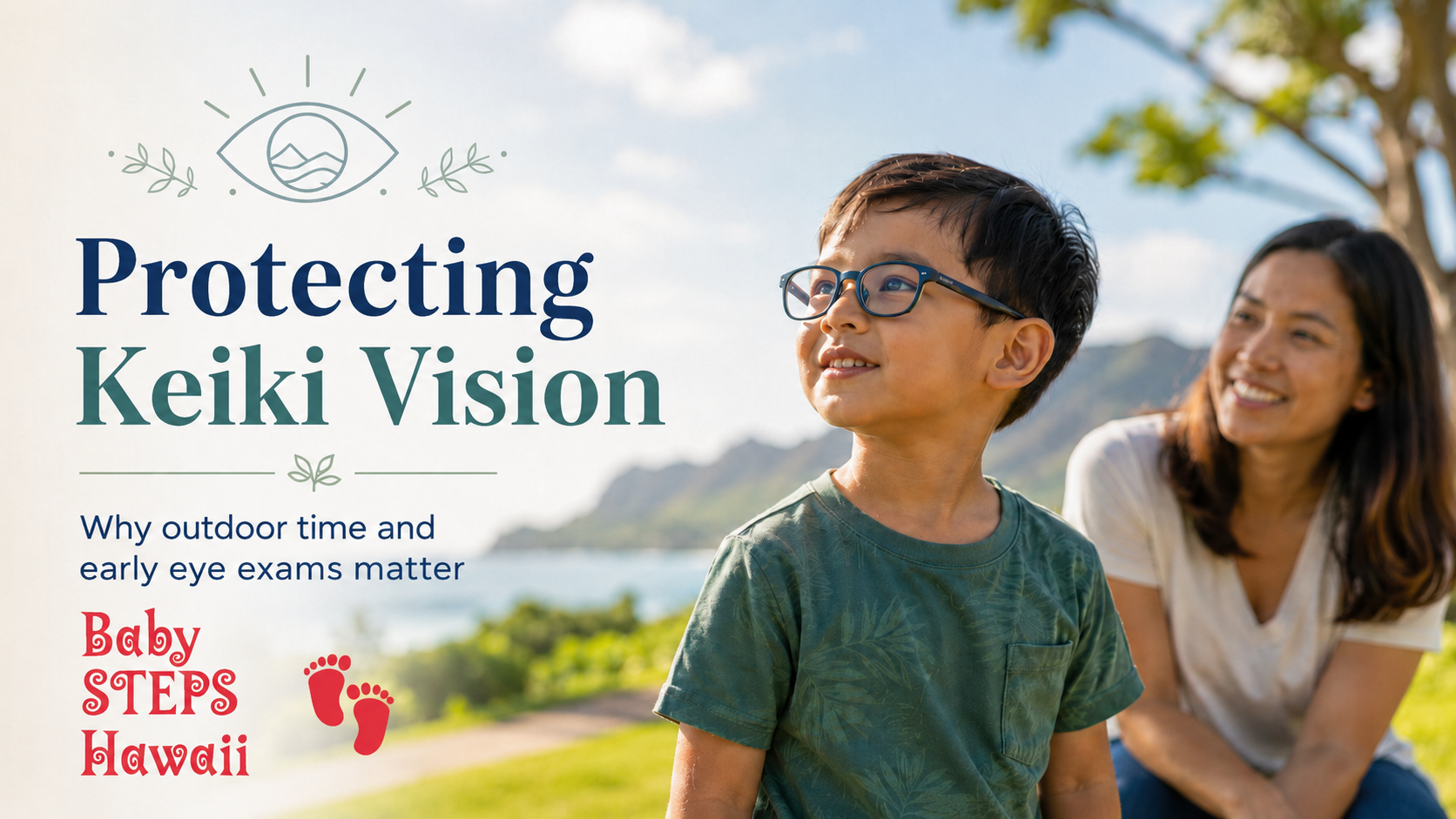
Nearsightedness is becoming more common in children — but new research continues to show that families are not powerless.
Myopia, also called nearsightedness, happens when a child can see nearby objects clearly but has trouble seeing things far away. A child may squint to see the board at school, sit close to the TV, hold books or screens close to their face, complain of eye strain, or seem to avoid activities that require distance vision. The National Eye Institute notes that myopia often begins between ages 6 and 14 and can worsen into the early twenties. Children with family members who are nearsighted are also at higher risk. (National Eye Institute)
For Baby STEPS Hawaiʻi, this matters because healthy vision is part of healthy early learning. When a child cannot see clearly, it can affect school readiness, confidence, attention, reading, play, and participation. The good news: research continues to point to practical steps families can take early.
The big takeaway: get keiki outside every day
One of the strongest and simplest messages for families remains this:
Outdoor time matters.
Research continues to show that children who spend more time outdoors are less likely to develop myopia. The American Association for Pediatric Ophthalmology and Strabismus recommends children try to spend at least 2 hours outside per day as part of myopia prevention and control. (AAPOS)
That does not mean families need a perfect schedule or an expensive program. It can look like:
Playing outside before dinner
Walking to the mailbox or around the block
Park time after school
Beach, yard, garden, or playground time
Outdoor reading or homework breaks
Weekend family time outside
The goal is not perfection. The goal is more daylight, more distance viewing, and more breaks from constant close-up work.
Screen breaks help, too
The CDC recommends limiting screen time, encouraging frequent breaks from near-vision activities, supporting sleep, and spending time outdoors to protect children’s vision. (CDC)
For families, a simple rule is:
Near work needs far breaks.
If keiki are reading, drawing, gaming, watching videos, or doing homework up close, build in short breaks where they look across the room, out a window, or go outside. Tiny habits count.
Eye exams matter — even if your child passed a screening
Vision screenings are helpful, but they are not the same as a comprehensive eye exam. The CDC explains that a vision screening helps identify children who may need more care, while a comprehensive eye exam by an optometrist or ophthalmologist can diagnose and treat vision or medical eye problems. (CDC)
This distinction matters because children may not know their vision is blurry. To them, blurry may feel normal.
Parents and caregivers should consider a comprehensive eye exam if a child:
Squints or rubs their eyes often
Sits very close to screens or books
Complains of headaches or tired eyes
Avoids reading or close-up activities
Has trouble seeing the board or signs far away
Has one or both parents with myopia
Shows changes in school performance, attention, or confidence
New research is expanding treatment options
Recent research shared during the 2026 ARVO vision research meeting points to continued progress in myopia prevention and management. The research reinforces what Baby STEPS Hawaiʻi has already been sharing: lifestyle matters, early identification matters, and families should talk with pediatric eye care professionals when risk signs appear.
Some studies highlighted promising tools such as specialized myopia-control lenses, low-dose atropine eye drops, and multifocal contact lenses. The American Association for Pediatric Ophthalmology and Strabismus notes that low-dose atropine eye drops, multifocal contact lenses, and increased outdoor time are among the options currently used or studied to help slow progressive myopia in children. (AAPOS)
Researchers are also studying newer areas, including how inflammation may influence myopia development and whether some treatments may help manage progression beyond childhood. These findings are promising, but families should not try to self-treat myopia. A child’s eye care plan should be guided by a qualified optometrist or ophthalmologist.
What about adults with myopia?
Most public awareness focuses on children because childhood is when myopia often begins and progresses. But newer research suggests myopia progression may continue for some young adults, and studies are exploring whether multifocal soft contact lenses or other therapies may help reduce progression. One ARVO 2026 research summary noted that young adult myopes wearing multifocal soft contact lenses had less one-year refractive progression than those wearing standard single-vision soft contacts, though larger prospective studies are still needed. (Review of Myopia Management)
For adults, especially those with high myopia, regular eye care is important. High myopia can increase the risk of serious eye problems, including retinal detachment. (National Eye Institute)
What parents can do this week
Here are five simple steps families can take right now:
1. Aim for more outdoor time.
Try for 2 hours a day when possible, or build toward it with small daily outdoor breaks.
2. Watch for signs of blurry distance vision.
Squinting, sitting close, headaches, or avoiding reading may be clues.
3. Schedule a comprehensive eye exam if you have concerns.
Do not rely only on school or pediatric vision screenings.
4. Ask about family history.
If one or both parents are nearsighted, tell your child’s eye doctor.
5. Talk to an eye care professional about myopia management.
Glasses correct vision, but some treatment options may help slow progression.
Small steps can protect big futures
Healthy vision supports learning, confidence, play, and school readiness. While families cannot control every risk factor, they can take small, meaningful steps: more outdoor time, balanced screen habits, regular eye care, and early conversations with pediatric eye specialists.
Bright light. Bright eyes. Brighter futures for our keiki.